
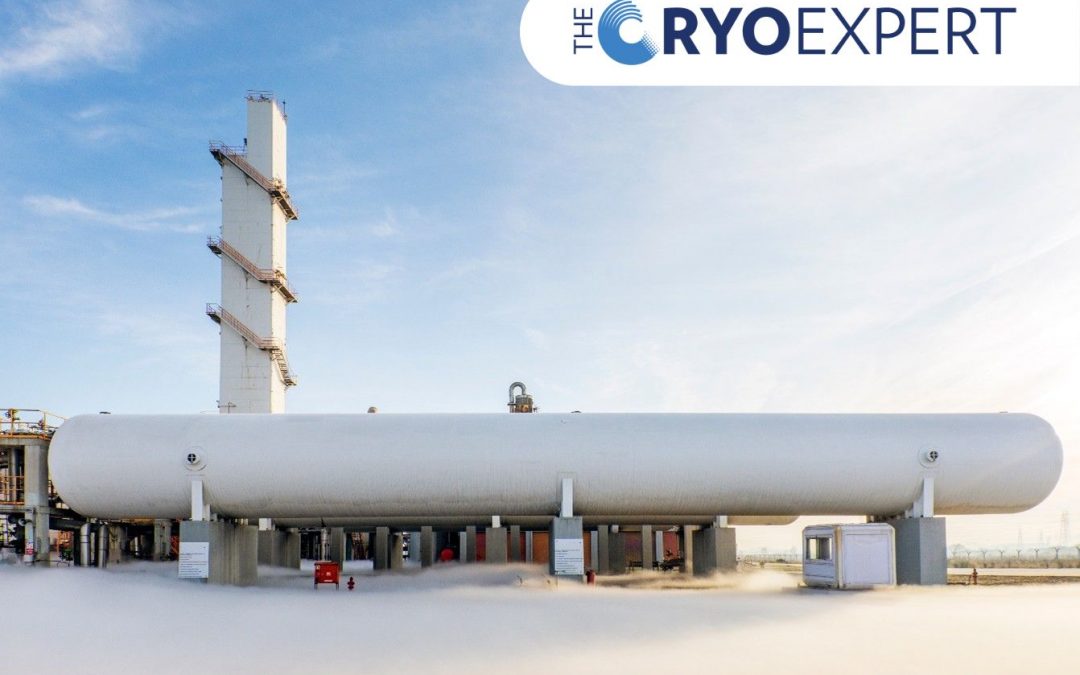
Cryogenic distillation forms the heart of every Air Separation Unit (ASU). It separates air into high-purity oxygen, nitrogen, and argon by taking advantage of their different boiling points at cryogenic temperatures. Because these boiling points differ by only a few degrees, even small changes in operating conditions can significantly affect product purity and energy consumption.
How Cryogenic Air Separation Works
The process begins by compressing ambient air before removing impurities such as water and carbon dioxide. The clean air is then cooled to cryogenic temperatures until part of it liquefies.
The partially liquefied air enters a distillation system, typically consisting of a high-pressure (HP) column and a low-pressure (LP) column connected through a condenser-reboiler. The high-pressure column performs the initial separation, while the low-pressure column produces high-purity products.
Nitrogen, with a boiling point of -196°C, concentrates at the top of the column. Oxygen, which boils at -183°C, collects at the bottom as a liquid, while argon is recovered through a dedicated side column because its boiling point lies between oxygen and nitrogen.
The Importance of Reflux Ratio
The reflux ratio is one of the most important operating parameters in a cryogenic distillation column. It represents the amount of condensed liquid returned to the column compared with the amount withdrawn as product.
Increasing the reflux ratio improves separation by enhancing contact between liquid and vapour. This produces higher product purity and makes better use of the available separation stages.
However, higher reflux also increases refrigeration demand and condenser-reboiler duty, raising the overall energy consumption. Finding the right balance between purity and operating cost is therefore essential.
Column Efficiency
Theoretical calculations assume perfect separation at every stage, but real columns never achieve ideal performance. Vapour-liquid mass transfer, pressure drop, and flow distribution all reduce column efficiency.
For packed columns, engineers often evaluate performance using the Height Equivalent to a Theoretical Plate (HETP). Tray columns rely on tray efficiency to compare actual and theoretical performance.
Operating conditions also play a major role. Variations in feed composition, turndown operation, or poor vapour and liquid distribution can quickly reduce separation efficiency.
Design Considerations
Cryogenic distillation columns do not operate in isolation. Their performance depends on close integration with the rest of the process, particularly the condenser-reboiler, refrigeration cycle, and heat exchangers.
Engineers must carefully optimize operating pressures, feed conditions, and heat integration while maintaining stable flow distribution throughout the columns. Small deviations can significantly reduce purity or increase energy consumption.
Conclusion
Cryogenic distillation allows the production of high-purity oxygen, nitrogen, and argon with remarkable efficiency. Although the temperature differences between these products are very small, careful control of reflux ratio, column efficiency, and operating conditions makes highly effective separation possible.
In cryogenic engineering, successful distillation relies on precise process control as much as on column design. Small thermodynamic differences, managed correctly, deliver the high product purity required by modern industrial gas applications.

References and further reading
- NIST Chemistry WebBook — reference thermophysical data for gases
- European Industrial Gases Association (EIGA) — safety and standards publications
- International Institute of Refrigeration (IIR)
- Cryogenics (Elsevier) — peer-reviewed journal on cryogenic engineering
- Linde Engineering — air separation and liquefaction technology
Continue reading on The Cryoexpert
- Plate-Fin Heat Exchangers (PFHE)
- Cold Box Design Principles
- Industrial Gas Applications of Cryogenics
- Cryogenic Compressors
- Cryogenic Process Control and Automation
Working on a cryogenic project?
Get expert engineering support for ASU, cryogenic storage, vacuum insulated piping, vaporization and regasification projects — from feasibility studies to commissioning. Tell us about your project and get a response within one business day.
For additional safety guidance on cryogenic air-separation operations, see EIGA Doc 194: Safe design and operation of on-site nitrogen plants.