
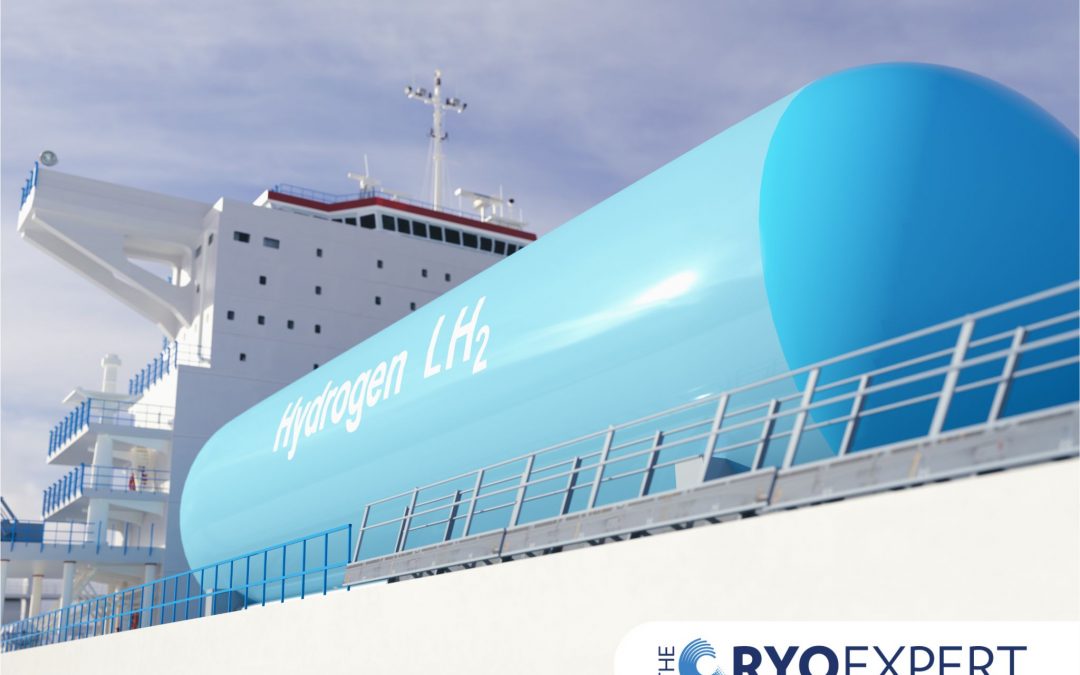
Liquid hydrogen (LH₂) represents one of the most demanding applications in cryogenic engineering. With a boiling point close to -253°C, it operates only a few degrees above absolute zero. At these temperatures, molecular behaviour, very low density, and unavoidable heat ingress become major design challenges. Successful LH₂ systems require careful attention to liquefaction, storage, transport, and boil-off gas management.
Ortho-Para Conversion
Hydrogen exists in two molecular forms: ortho-hydrogen and para-hydrogen. At ambient temperature, hydrogen contains approximately 75% ortho and 25% para molecules. At liquid hydrogen temperature, however, nearly all the hydrogen must be in the para form to remain stable.
The conversion from ortho to para releases heat. If this reaction occurs after liquefaction, the heat generated inside the storage tank increases boil-off and can lead to significant product losses.
To prevent this, liquefaction plants use catalytic converters in several stages to gradually transform hydrogen into its equilibrium para state before storage. This conversion is an essential part of every LH₂ liquefaction process, not an optional improvement.
The Challenge of Low Density
Liquid hydrogen has a density of only about 70 kg/m³, roughly six to seven times lower than LNG. Although hydrogen contains a high amount of energy per kilogram, it stores much less energy per unit volume.
As a result, LH₂ installations require much larger storage tanks and transport vessels than equivalent LNG systems. The larger surface area also increases heat ingress, making insulation even more critical.
Boil-Off Gas Management
Even with excellent insulation, some heat inevitably enters the tank and causes liquid hydrogen to evaporate. Well-designed storage systems typically limit boil-off to around 0.2% to 1% per day, although actual losses depend on tank size, insulation quality, and operating conditions.
Smaller tanks generally experience higher percentage losses because of their larger surface-to-volume ratio. Filling operations, product withdrawal, and frequent pressure changes can also increase boil-off.
Rather than venting the gas, modern installations recover boil-off gas (BOG) for reliquefaction, fuel, or other process uses whenever possible.
Design Considerations
Designing an LH₂ system requires much more than selecting a storage tank. Vacuum insulation combined with multi-layer insulation (MLI) is essential to minimise heat transfer. Engineers must also manage hydrogen embrittlement, ensure exceptional leak tightness because of hydrogen’s small molecular size, and address its wide flammability range through appropriate safety measures.
These challenges are closely linked. Low density requires larger tanks, larger tanks increase heat ingress, and additional heat generates more boil-off. Poor ortho-para conversion further increases these losses, making overall system optimisation essential.
Conclusion
Liquid hydrogen pushes cryogenic engineering to its limits. Its extremely low boiling point, low density, and unique molecular behaviour require specialised equipment and careful process design.
Successful LH₂ systems rely on complete ortho-para conversion, highly efficient insulation, effective boil-off gas management, and rigorous control of operating conditions. In liquid hydrogen applications, maintaining stability is often a greater engineering challenge than achieving cryogenic temperatures themselves.

Further reading
Working on a cryogenic project?
Get expert engineering support for ASU, cryogenic storage, vacuum insulated piping, vaporization and regasification projects — from feasibility studies to commissioning. Tell us about your project and get a response within one business day.