
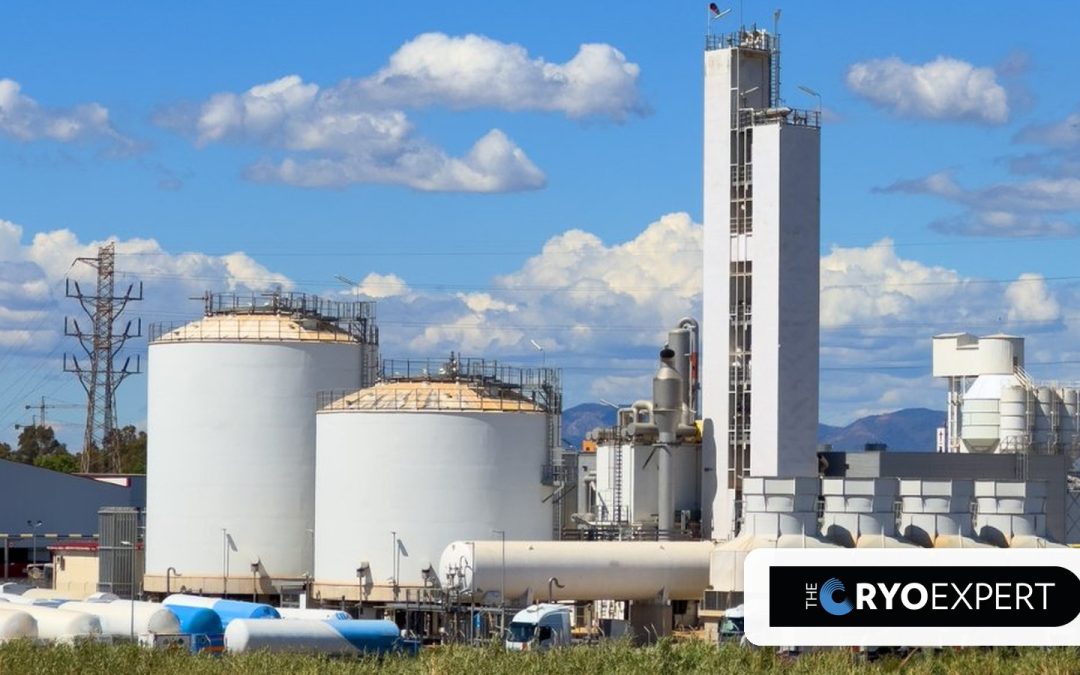
Frost heave can lift and crack the base of a flat bottom cryogenic tank. Cold from the inner vessel travels down through the base and freezes the soil below. Frozen soil grows, and growing soil pushes up on the slab. This article explains how foundation heating prevents the problem and what specifiers should define.
Why frost heave threatens flat bottom cryogenic tanks
A cryogenic liquid sits only a few metres above the ground. Even with thick floor insulation, some cold still reaches the concrete base. Over months, that cold freezes the water in the soil under the tank. Ice forms in lenses, and the soil expands upward with great force. A large flat bottom cryogenic tank is heavy, but frost heave can still crack the slab or tilt the tank.
How foundation heating works
Designers build the foundation heating system into the slab, or under it. These elements keep the soil above 0 °C all year. Electric cables are the most common choice. Some designs use warm fluid in pipes instead. In either case, the system adds a small and steady amount of heat to offset the cold coming down from the tank.
Elevated slab or heated slab on grade
Two foundation concepts dominate. An elevated slab sits on piles, with an open air gap below it. Natural air flow keeps the ground warm, so no heating is needed. A slab on grade sits directly on the soil, and it needs an active heating system. The soil survey, the site climate, and the tank load decide which concept fits. Therefore, the geotechnical report belongs at the start of the design, not the end.
Redundancy and monitoring
Foundation heating cables sit under a loaded tank, so nobody can repair them later. For this reason, designers install spare circuits from the first day. Temperature sensors in the slab show whether the soil stays above freezing. In addition, alarms warn operators when a circuit fails. Good logs from the first year give a baseline for all later checks on the foundation heating system.
What to define in the specification
The spec should state the design temperature of the soil, the heating capacity, and the number of spare circuits. It should require sensor locations and alarm levels. It should also say who tests the system before cool-down. Also define the power supply route, since a long outage on a cold site can threaten the foundation. Finally, set the acceptance tests for the heating system in the contract.
Foundation heating during construction and cool-down
The foundation heating system starts working long before the first litre of product arrives. Crews test every circuit during foundation work, because later repairs cost far more. During cool-down, the foundation sees its first real thermal load. Therefore, operators should watch the slab temperatures closely and compare them with design values. A steady trend confirms that the heating and the floor insulation work as planned.
Common mistakes to avoid
Most foundation problems start with a short soil survey. A survey that misses a wet layer can hide a serious frost risk. Another mistake is to switch off the heating after a few quiet years. Cold keeps flowing as long as the tank holds product, so the heating must stay on. Similarly, cables laid without spare circuits turn a single fault into a major repair.
Conclusion
Foundation heating protects the flat bottom cryogenic tank from a slow and silent failure. Soil data, a clear concept, spare circuits, and active monitoring work together to keep the ground above freezing. Each element is cheap to specify and costly to add later.
Engineers who fix these terms at tender stage protect both the tank and the schedule. A frost-safe base then supports the tank for its full service life.
References and further reading
- API 620 tanks: low-pressure, large-volume storage (STI/SPFA)
- Frost heaving: how freezing soil lifts structures (Wikipedia)
- EIGA publications on industrial gas safety
Continue reading on The Cryoexpert
- Flat bottom cryogenic tank specification: a practical checklist
- The perlite annulus in flat bottom cryogenic tanks
- API 620 vs EN 14620 for flat bottom cryogenic storage tanks
EIGA’s publication on the safe design and operation of cryogenic enclosures offers additional industry guidance relevant to assessing cryogenic hazards around storage installations.