
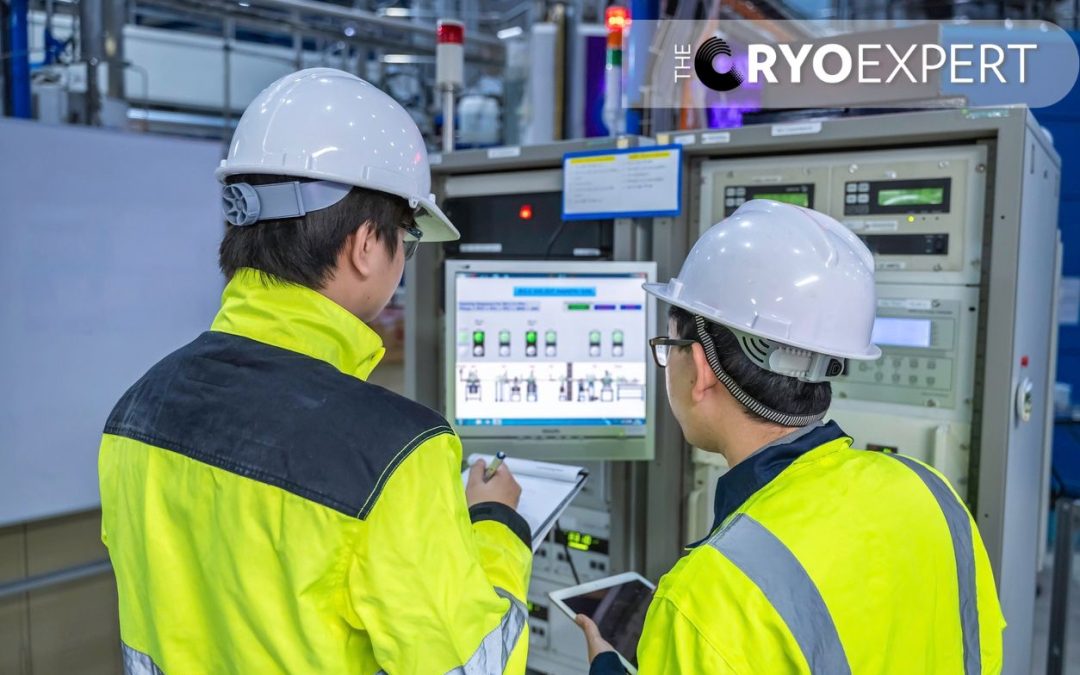
Mechanical completion is a key milestone in any cryogenic project, but it does not mean the plant is ready to run. Before LNG, LIN, LOX or another cryogenic product can enter the system, the team must follow a controlled sequence. Commissioning a cryogenic plant means inspecting, cleaning, testing, inerting, cooling down and starting each system in order.
Good commissioning links construction with operation. It also gives the first real proof that the plant performs as designed.
Mechanical completion comes first
Commissioning starts by checking the plant against the approved design. The team checks equipment, piping, valves, instruments, wiring, insulation, supports and safety systems against drawings and specs.
The team then sorts punch-list items by their impact on safe running. Critical items must close before startup. Minor ones may stay open for a while. Therefore, the goal is simple: prove the plant is ready for pre-commissioning.
Pre-commissioning prepares each system
Pre-commissioning proves that each system is clean and works as built. Typical work includes pipe cleaning or blowing, instrument checks, valve tests, loop tests and rotation checks. Safety interlocks get tested too.
The team also finishes leak and pressure tests within defined system limits. At this stage, they work system by system. As a result, the plant is never started as one big unknown.
Inerting and drying are critical
Water and oxygen cause trouble in cold service. Leftover water freezes once the metal gets cold, and ice can block valves, gauges and narrow paths. Oxygen in the wrong place can also raise safety issues.
Therefore, teams purge the systems with dry nitrogen before any cryogenic fluid enters. They keep purging until tests show the target oxygen level and dew point at each measuring point. One nitrogen bottle at a single point is not enough, because dead legs and low-flow zones dry out last.
Leak testing before cooldown
A joint that feels tight at room temperature may leak at -160 °C. So the team tests flanges, valves, seals and welds before cooldown, while everything is still easy to reach.
Some checks also run during or after cooldown. Thermal contraction shifts loads and seal gaps, so a retest often makes sense.
Cooldown must be controlled
Pouring cryogenic liquid into warm steel creates huge temperature swings. If the plant cools too fast, parts shrink at different speeds and stresses build up.
Therefore, the team follows a fixed cooldown plan for tanks, piping, pumps and exchangers. They respect the stated cooling rates and limits. Operators watch temperatures, pressures, levels, vents and pipe movement the whole time. Cooldown is not just about getting cold. The plant must get cold without passing its limits.
From cooldown to first product
Once the plant is cold, operators start each machine in a set order: pumps, compressors, vaporizers, coolers and control valves. They then trim flows, pressures and control loops toward normal running.
The first on-spec product is a milestone, but commissioning a cryogenic plant does not stop there.
Performance testing confirms the design
With stable running, the team runs performance tests against the contract guarantees. These may cover output, product quality, power draw, heat leak, pressure drop, boil-off or outlet temperature.
However, test conditions must match the guarantee conditions. Otherwise the numbers lead to wrong conclusions. Good tests therefore need good instruments, steady running and clear pass rules.
Why commissioning a cryogenic plant matters
Commissioning a cryogenic plant turns finished steel into a working plant. Mechanical completion proves it is built right. Pre-commissioning checks each system. Inerting and drying protect the cold sections. Leak tests and a slow cooldown protect the metal. Operators then start up and produce.
Finally, performance tests prove the plant meets its promises, and commissioning a cryogenic plant ends on evidence rather than hope. In cryogenic engineering, first product is not just the moment the plant gets cold. It marks the end of a planned sequence that turns equipment into an operating system. For more, see our guide to the cryogenic equipment datasheet and our article on API 620 versus EN 14620.
Commissioning readiness checklist
A one-page review covering mechanical completion, cleaning and drying, leak and function testing, cooldown preparation and performance tests. It includes the five hold questions that decide whether the plan is ready for first product.
Download the checklist (PDF) Ask a question about your plant
References and further reading
- HSE guidance on design codes and plant technical measures
- EIGA publications on commissioning and inerting
- NIST Chemistry WebBook: fluid properties for cooldown planning
- Cryogenics: an overview
- Liquefaction of gases – thermodynamic basis of gas plants.
Continue reading on The Cryoexpert
Preparing a cryogenic plant for commissioning?
Commissioning problems usually start long before first product, in incomplete checklists and unclear hold points. Send the plant scope, fluids and current completion status to review where the gaps are.