
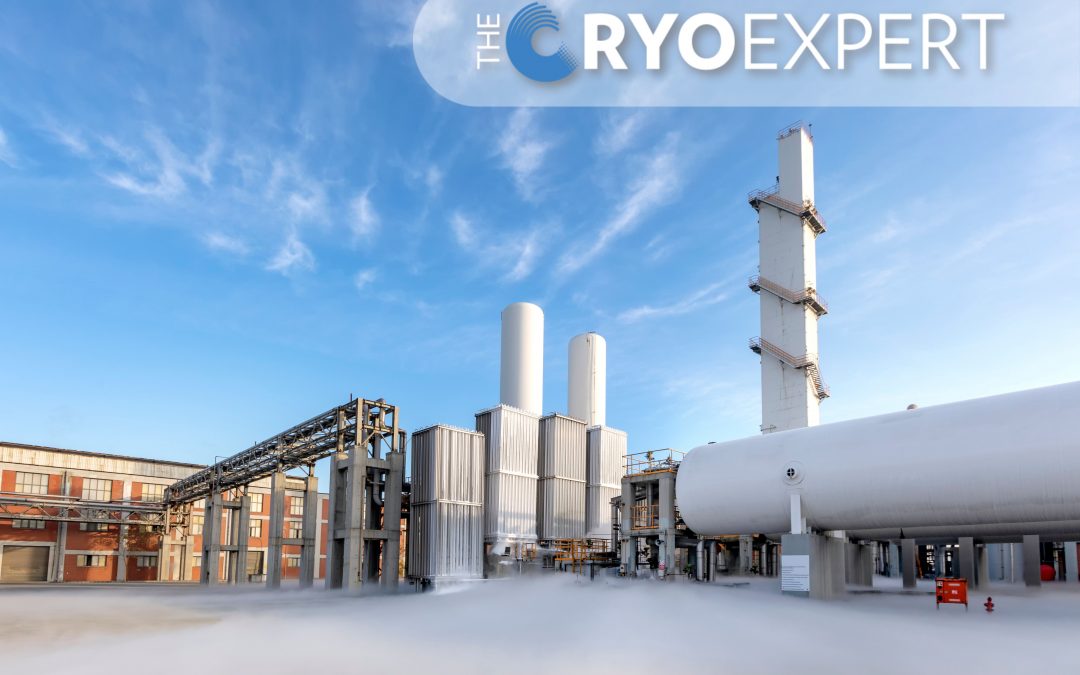
Cryogenic Tank Pressure Control ensures stable operation in storage systems where heat ingress continuously generates vapor. In practice, cryogenic tanks behave as self-pressurizing systems. Therefore, control strategies must maintain pressure within limits while guaranteeing reliable downstream supply.
Cryogenic Tank Pressure Control: Pressure Build-Up Units (PBU)
First, pressure build-up units (PBU) increase tank pressure when demand requires it. Engineers vaporize a small portion of liquid in a dedicated heat exchanger and return the generated gas to the tank.
As a result, PBUs:
- Maintain stable delivery pressure
- Ensure adequate NPSH for pumps
- Support reliable withdrawal conditions
But if you make a PBU too big, it will waste energy and cause pressure to go up and down. So, it’s really important to get the right size.
Cryogenic Tank Pressure Control: Economizers
Economizers also help deal with extra pressure by sending vapor somewhere else instead of just releasing it. The people in charge send the boil-off gas to where it can be used later.
Consequently, economizers:
- Reduce tank pressure
- Minimize product losses
- Improve overall system efficiency
But for this to work, the system needs to be able to handle the pressure and flow of gas that’s being produced. If it can’t, then the extra gas just gets wasted.
Control Philosophy in Cryogenic Tank Pressure Control
When it comes to controlling things, managing pressure is really important and it relies on two main functions that work well together.
- PBU increases pressure when it drops too low
- Economizer reduces pressure when it rises too high
Therefore, the objective is to maintain pressure within a narrow operating band.
Typically, engineers apply the following strategy:
Prioritize economizer operation to utilize available gas
Activate PBU only when necessary
Design Insight
But if the system isn’t set up just right, it can actually become unstable. Like when the PBU and economizer are working against each other, it can cause the pressure to keep going up and down in a cycle.
As a result, operators may observe:
- Excess venting
- Unstable downstream supply
- Reduced efficiency
Thus, engineers must carefully define setpoints and control logic.
Takeaway
Ultimately, Cryogenic Tank Pressure Control depends on:
- Correct PBU sizing
- Effective economizer integration
- Well-defined control strategies
So, controlling pressure is not just a simple matter of letting things happen on their own. It’s actually a very active process that keeps a delicate balance between the heat that’s coming in, what the process needs, and how the system reacts to all of this.

References and further reading
- European Industrial Gases Association (EIGA) — safety and standards publications
- Compressed Gas Association (CGA) — industry standards
- American Petroleum Institute (API) — API 620 storage tank standard
- ISO — international standards for cryogenic vessels and components
Continue reading on The Cryoexpert
- Cryogenic Fluid Storage Design
- Boil-Off Gas Management
- Cryogenic Pumps and Pressure Build-Up Systems
- Cryogenic Vaporization Technologies
- Defrosting and Operational Cycles of Vaporizers
Further reading
Working on a cryogenic project?
Get expert engineering support for ASU, cryogenic storage, vacuum insulated piping, vaporization and regasification projects — from feasibility studies to commissioning. Tell us about your project and get a response within one business day.
For the European Union’s pressure-equipment requirements, consult EU Pressure Equipment Directive 2014/68/EU.
Further technical reference: European Commission Pressure Equipment Directive information.