
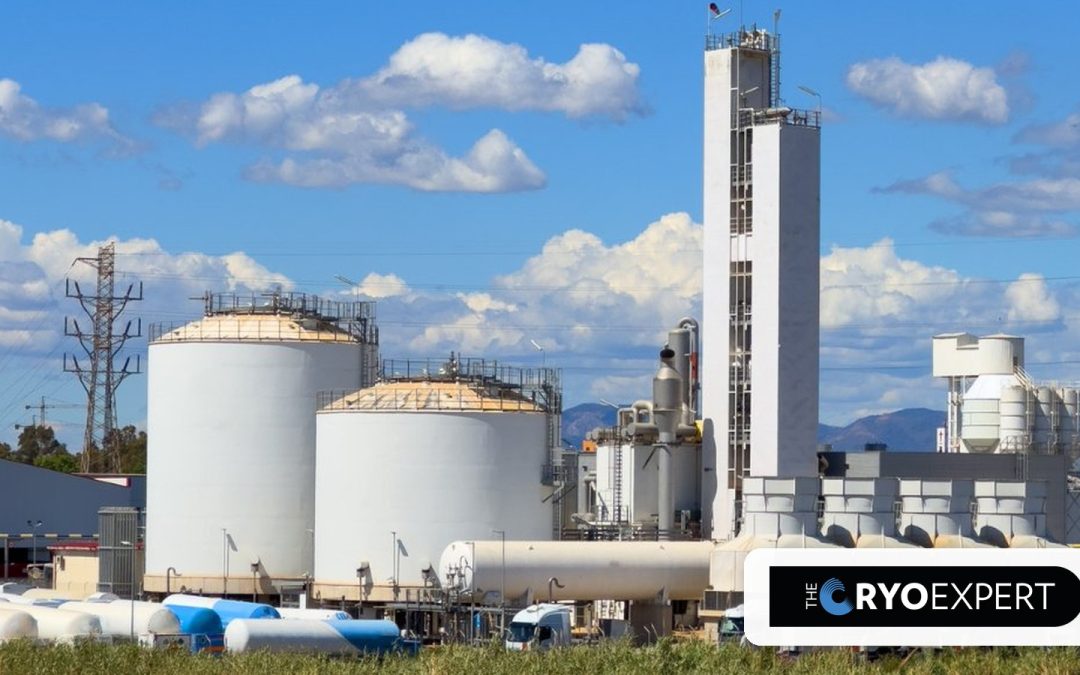
Large cryogenic plants store most of their product in flat bottom cryogenic storage tanks. Two design codes rule these tanks: API 620 and EN 14620. Both lead to safe tanks, but they grew from two work worlds. Pick the wrong one and the project pays. This guide shows what each code covers and how to choose.
What API 620 covers
API 620 sets the design and build rules for large welded tanks with low internal pressure. Its scope also covers stored products at low temperatures. For this reason, US projects often pick API 620 for their flat bottom cryogenic storage tanks. The code sets design stresses, material choice, weld rules, and test levels. However, it leaves many details open. Engineers close those gaps with project specs and system codes such as API 625.
What EN 14620 covers
EN 14620 is the European code for tanks built on site. It applies to steel tanks with a flat bottom that hold products between 0 °C and −165 °C. The code splits its scope into parts. These parts deal with the steel shell, the concrete base, the insulation, and the handover tests one by one. As a result, each part can go to the right expert. That structure keeps roles clear from design through build.
Key differences for flat bottom cryogenic storage tanks
The scopes differ first. API 620 accepts internal pressure up to about one bar. EN 14620 targets tanks that run close to the air pressure around them. Therefore, the pressure range answers the first screening question.
The insulation rules differ too. EN 14620 has a whole part on insulation, with clear rules for the gap between the two tank walls. API 620 says far less about it. For this reason, US projects rely on owner specs to define the fill material, its density, and how much it will settle.
How to choose the right code
Where the project sits usually settles the choice. US-built projects cite API 620, often with client add-ons. European contracts cite EN 14620, and the Pressure Equipment Directive then frames the legal side. However, mixed tenders exist. Clients in the Middle East and Asia at times cite both codes in one bid package. In that case, the spec must state which code wins when they clash. Set this before award, not after.
Practical points for specifiers
A few details deserve early care. Name the code and its edition in the contract. Define the border between the tank code and the piping code, for example EN 14620 with EN 13480. In addition, write the insulation terms in full: fill material, fill process, settling room, and ports for later top-up. Also fix the test and check levels early, because they drive cost more than most buyers expect. Finally, align the vent design with the boil-off system, since the tank and its safety vents must work as one.
Materials at low temperature
Both codes demand materials that stay tough at low temperature. Inner vessels for LNG service use 9 % nickel steel or aluminium alloys, while austenitic steel serves oxygen and nitrogen tanks. Therefore, the spec should tie each material grade to a tested impact level. In addition, weld rules matter as much as plate rules. Most failures start at a joint, so weld checks and repair rules deserve the same care as the shell design.
Conclusion
API 620 and EN 14620 both yield safe flat bottom cryogenic storage tanks. They differ in scope, layout, and insulation rules. Match the code to the project region and its pressure range. That single step prevents late redesign and split blame.
Specifiers add value by fixing code lines, interfaces, and insulation terms at tender stage. Clear choices there protect both the budget and the plan through build and start-up.
References and further reading
- API 620 tanks: low-pressure, large-volume storage (STI/SPFA)
- API 620: Design and Construction of Large, Welded, Low-Pressure Storage Tanks (PDF)
- Choosing between API 620 and 650 for your storage tank
Continue reading on The Cryoexpert
- The perlite annulus: design, filling and long-term performance
- Cryogenic fluid storage design: stability beyond storage
- Cryogenic tank pressure control: balancing boil-off and demand
- Materials selection for cryogenic service
Further standards references
For European tank projects, consult the applicable national adoption and project jurisdiction. BSI standards catalogue provides access to published British and adopted European standards.
Further references
The British Standards Institution provides the current scope and publication details for BS EN 14620-1:2024, which addresses general requirements for site-built, flat-bottomed tanks storing refrigerated liquefied gases.
Additional technical references: gasworld industry news and analysis, EIGA publications for industrial gases, and API standards programme and catalogue.