
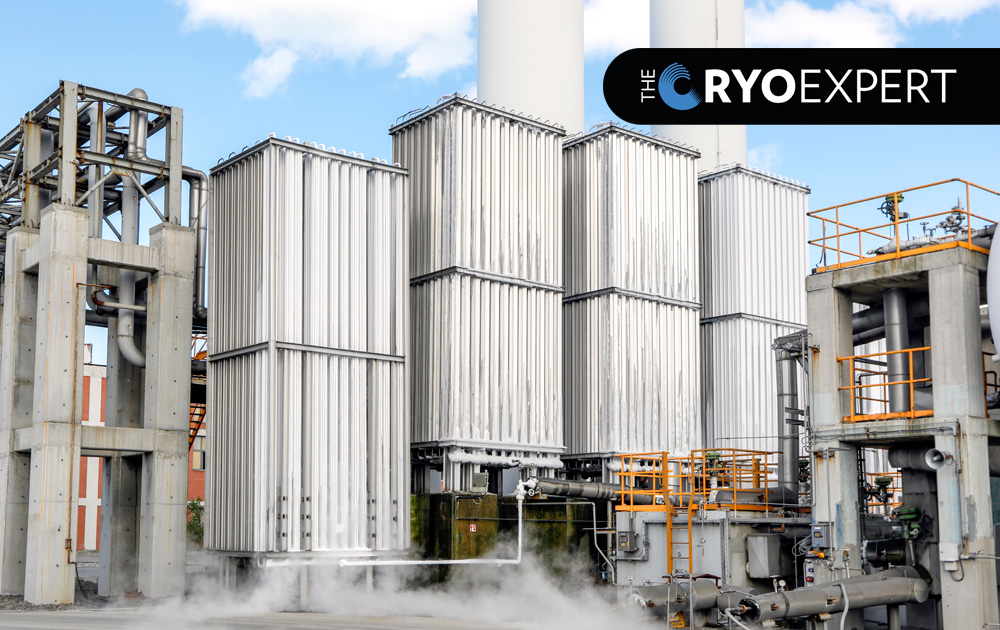
Cryogenic Vaporization Technologies define how efficiently a system converts liquid into gas. In practice, vaporization may seem simple; however, the selected heat source directly impacts efficiency, footprint, and operability. Therefore, engineers must carefully match the technology to the process conditions and operating philosophy.
Cryogenic Vaporization Technologies: Ambient Air Vaporizers (AAV)
First, ambient air vaporizers use atmospheric heat through natural convection. As a result, they operate without external energy input.
Key advantages include:
- Low OPEX
- Simple and robust design
But how well they work really depends on the weather around them, like how hot or cold it is, how humid it is, and if there’s ice. So, engineers usually pick these vehicles for jobs that aren’t too tough and for places where the weather doesn’t change much.
Cryogenic Vaporization Technologies: Water Bath Vaporizers (WBV)
Some vaporizers use a water bath to heat up the substance. This type of system has a special water reservoir that is heated, which gives a steady and controlled amount of heat that doesn’t depend on the temperature and humidity around it. This means that the heat can be kept at a consistent level, no matter what the ambient conditions are like.
Therefore, WBVs offer:
- Reliable heat transfer
- Stable operation in cold environments
But they need fuel or electricity to run, which adds to the cost of operating them. So, engineers usually use these systems for jobs that need to run all the time or in really tough weather conditions.
Cryogenic Vaporization Technologies: Steam Vaporizers
Steam vaporizers are also able to use the steam from plants as a source of heat, which is really useful. This means they can transfer heat really efficiently and are designed to be compact, taking up less space.
However, this solution requires:
- Steam availability
- Condensate management
Accordingly, engineers prefer steam vaporizers in industrial sites with existing steam networks.
Cryogenic Vaporization Technologies: Electric Vaporizers
Finally, electric vaporizers use resistive heating elements. In practice, they provide precise control and compact installation.
Key benefits include:
- Accurate temperature control
- Flexible operation
But when it comes to high electricity demand, it can really drive up operating costs. So, engineers usually choose electric vaporizers for smaller jobs or when they’re only needed every now and then.
Selection Logic in Cryogenic Vaporization Technologies
From a design perspective, selecting the right technology depends on multiple parameters:
- Flow rate and peak demand
- Ambient conditions (temperature, humidity, freeze periods)
- Energy availability (electricity, gas, steam)
- Operating profile (continuous vs intermittent)
For example, a mild climate with steady load favors AAV. By contrast, cold climates or peak demand scenarios favor WBV or steam systems.
Takeaway
Ultimately, Cryogenic Vaporization Technologies require multi-variable optimization.
- AAV → low OPEX, climate-dependent
- WBV → stable but energy-intensive
- Steam → efficient when available
- Electric → flexible and compact
In conclusion, vaporization does not simply add heat. Instead, it represents a strategic design choice that balances energy, reliability, and cost.

References and further reading
- European Industrial Gases Association (EIGA) — safety and standards publications
- Compressed Gas Association (CGA) — industry standards
- Chart Industries — cryogenic equipment and storage systems
- Cryogenics (Elsevier) — peer-reviewed journal on cryogenic engineering
Continue reading on The Cryoexpert
- Heat Transfer at Cryogenic Temperatures
- Defrosting and Operational Cycles of Vaporizers
- Cryogenic Tank Pressure Control
- Boil-Off Gas Management
- Plate-Fin Heat Exchangers (PFHE)
Working on a cryogenic project?
Get expert engineering support for ASU, cryogenic storage, vacuum insulated piping, vaporization and regasification projects — from feasibility studies to commissioning. Tell us about your project and get a response within one business day.