
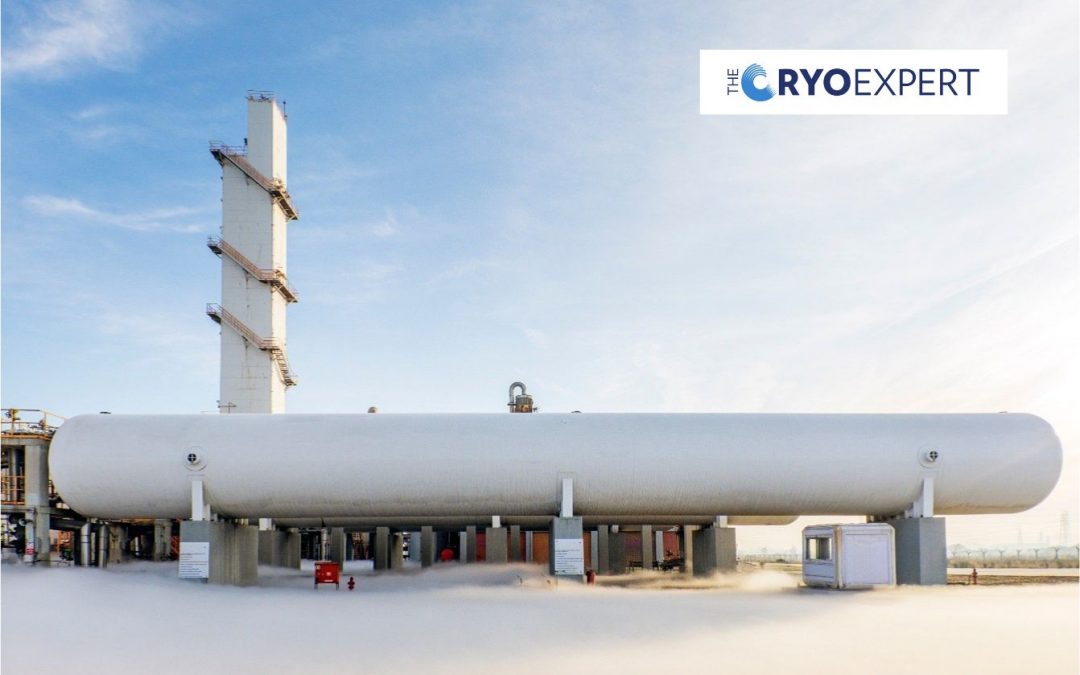
Cryogenic Fluid Storage Design:
Engineering for Stability and Safety
Cryogenic Fluid Storage Design is not just about holding a liquid—it is about maintaining thermodynamic stability over time. In practice, poor design leads to pressure build-up, stratification, and even rollover events. Therefore, engineers must treat storage tanks as dynamic systems rather than passive equipment.
Cryogenic Fluid Storage Design:
Tank Types and Applications
Different applications require specific storage philosophies
Full Containment Tanks
Used for large-scale LNG storage. Engineers combine an inner cryogenic tank with an արտաքին concrete containment. This design maximizes safety and minimizes leakage risk.
Vacuum Insulated Tanks
Typically used for LIN, LOX, and LCO₂. A double-wall structure with vacuum, perlite, or MLI reduces heat ingress. As a result, boil-off remains minimal.
ISO Tanks
These tanks are made to be moved around and used in different places. Even though they can’t hold a lot of stuff, they are really flexible and have a standard shape that makes them easy to use.
Stratification in Cryogenic Fluid Storage
Design As time passes, cryogenic liquids start to develop distinct thermal layers. Usually, the warmer and lighter liquid rises to the top, while the colder and denser liquid stays at the bottom. This happens because of a few reasons: the way the liquid is filled, which can be intermittent, the low circulation of the liquid, and the heat that seeps in from outside.
Consequently, stratification creates unstable temperature and density profiles.
Rollover Risk and Engineering Control
If stratification increases, a rollover event can occur. In that case, sudden mixing of layers generates rapid vaporization and sharp pressure rise. As a result, the system releases a large amount of boil-off gas (BOG).
To control this risk, engineers apply:
- Controlled filling procedures (bottom vs top)
- Recirculation systems
- Temperature and density monitoring
- Proper BOG handling capacity sizing
Takeaway
Ultimately, Cryogenic Fluid Storage Design balances thermal performance, operational flexibility, and safety. A tank does not behave as a static vessel; instead, it operates as a dynamic thermodynamic system.

References and further reading
- American Petroleum Institute (API) — API 620 storage tank standard
- ISO — international standards for cryogenic vessels and components
- European Industrial Gases Association (EIGA) — safety and standards publications
- NFPA 55 — compressed gases and cryogenic fluids code
- Chart Industries — cryogenic equipment and storage systems
Continue reading on The Cryoexpert
- API 620 vs EN 14620: standards for flat bottom cryogenic storage tanks
- Cryogenic Tank Pressure Control
- Cryogenic Piping Design
- Materials Selection for Cryogenic Service
- Cryogenic Insulation Technology
- LNG Value Chain Overview
Working on a cryogenic project?
Get expert engineering support for ASU, cryogenic storage, vacuum insulated piping, vaporization and regasification projects — from feasibility studies to commissioning. Tell us about your project and get a response within one business day.
For the applicable technical framework for static vacuum-insulated cryogenic vessels, see ISO 21009-2: Cryogenic vessels, static vacuum-insulated vessels.
Further technical reference: ISO 21009-2 guidance on cryogenic vessel design.